
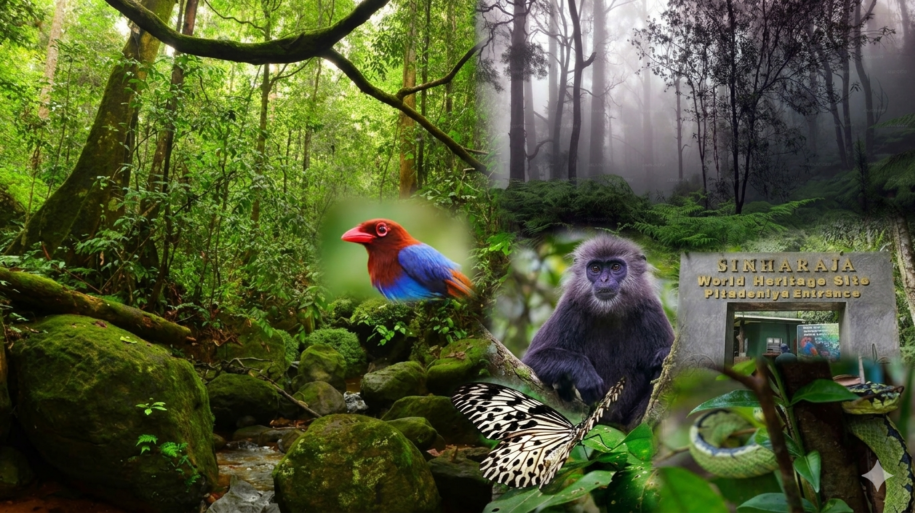
“Sinha” means lion. One of Sri Lanka’s major official languages is Sinhala, and the people who speak it are called Sinhalese. Even the popular rock fortress at the heart of Sri Lanka’s cultural triangle is called “Sinhagiri” or Sigiriya, meaning Lion Rock. In addition to this list, the last remaining extensive primary lowland rainforest in Sri Lanka is Sinharaja Forest Reserve (Lion King Forest). Each of these holds a unique long-standing bond with the beast. Yet, there are no lions in Sri Lanka.
How so? How did a being with such deep and massive cultural significance disappear from the island? How is Sinharaja forest linked to it?
What happened to the Sri Lankan Lions?
Panthera Leo Sinhaleyus is the scientific name for the subspecies of lions that once inhabited Sri Lankan lands. It is said to look physically much larger than the Indian lions of today. The palaeontologist, Paulus Deraniyagala, who named this species, derived its name from the Sinharaja Forest from where he got the first prehistoric fossil (a molar teeth) in 1938. This is what resulted in the discovery of Sri Lankan lions — a lost subspecies. For now, this means Sinharaja forest Reserve is the last and only known land in Sri Lanka with scientific evidence to say majestic lions once roamed around this island.
An interesting fact about the extinction of Sri Lankan lions is that it did not happen in recent times, but in 37,000 BCE. As per recorded history, this is the period when Homo Sapiens were growing more in number and symbolic behaviour such as tool-making, art, and music were born. However, one cannot easily arrive at the conclusion that humans were a reason or the sole reason for this tragedy. During this period, geographically, Sri Lanka was a very different place. It was an island of open grasslands, making it an ideal habitat for lions. This is not the case now. Rainforests such as Sinharaja eventually flourished with numerous trees due to the monsoon, which also could have restricted the living space for lions. But, were lions the only affected animals?
The Big Brothers of Sinharaja Forest Reserve
Particularly in Sinharaja Forest Reserve, another majestic being was almost facing a similar tragedy, if not for Loku Aliya and Panu Kota (brothers) — the last two remaining elephants, as named by the villagers. The place used to have a larger elephant population of around 40-50 in the 1920s. But with colonial tea plantation encroachments, human-elephant conflict, and habitat loss, the number has reduced to a mere two, although found in large numbers across other parts of the island. It’s sad how human activities such as logging, poaching, and habitat fragmentation throughout history have resulted in the similar extinction of many other animal species in this region. Even agriculture, which is the base for human settlement, has affected wildlife. For instance, as per the 1870s report, the traditional chena cultivation that involves a slash and burn method had eaten up the north and northwestern sides of the then vast forest area.
Sinharaja — Name Origin Story
Peradeniya Botanical Gardens runs 147 acres of curated collections. The orchid house alone justifies the entrance fee. Don’t miss the palm avenue or the bamboo grove. Seasonal beds rotate throughout the year.
Horton Plains National Park sits around 2,200 meters elevation. Rhododendrons bloom against grasslands and patches of cloud forest. Everyone rushes to World’s End for the view, but slow down—the best flowers line the walking paths before you get there.
Sinharaja Rain Forest earned UNESCO status protecting species found absolutely nowhere else. You can’t navigate this alone. Too dense, too easy to get lost, and you’ll walk past rare blooms without recognizing them. Guides aren’t cheap but they’re worth it.
Hakgala Botanical Garden specializes in temperate stuff. Roses thrive in the cool climate (averages around 16°C). Flowers that would wilt within hours down in Colombo grow perfectly here.
Temple Gardens add cultural weight to the flower viewing. Temple of the Tooth in Kandy, Kelaniya, the Anuradhapura monasteries—all maintain serious gardens featuring traditional worship flowers.
What Actually Works
Let’s trace back something. If the lions in Sinharaja went extinct around 37,000 BCE and if the Sri Lankan lion’s existence was proved and named only in 1938 after discovering the fossil,
- How did the Sinharaja forest get its name in the first place?
- Why did the people of Sri Lanka name several important places after lions and how did it grow into a culturally important animal?
To answer the first question, even before the excavation, Sinharaja forest was considered by Sri Lankans to be the final stronghold of the last standing lion in Sri Lanka. The factuality of this has not yet been proven. There is also a folklore about a mythical lion that lived in the forest representing a spiritual connection between the people and the island. This too could have been the reason for the name “Lion King Forest”. In addition to these, there’s a belief that the forest was a forbidden territory of an ancient Sinhalese “Raja” (King). Nevertheless, with Sri Lanka’s recorded history missing beyond the past 2500 years, it’s hard to say the exact name origin story. As far as we know, due to local beliefs and taboos against entering or damaging the forest, this remained a largely unexplored rainforest until the 1930s. The answer to the second question is a mystery that only the unrecorded history and maybe some archaeologists can answer.
What makes Sinharaja forest a UNESCO World Heritage site?
Sinharaja forest is a narrow belt of wet zone rainforest in the south‑west of Sri Lanka. With an area of approximately 11,187 hectares, it stretches across 21 km east-to-west and 7 km north-to-south.
As per the guidelines of World Heritage Convention, to be included in the list of 1240+ UNESCO World Heritage sites, it must meet at least one of the ten criteria that mark exceptional universal value. Sinharaja rainforest satisfies the following two criteria:
(ix) to be outstanding examples representing significant on-going ecological and biological processes in the evolution and development of terrestrial, fresh water, coastal and marine ecosystems and communities of plants and animals;
(x) to contain the most important and significant natural habitats for in-situ conservation of biological diversity, including those containing threatened species of outstanding universal value from the point of view of science or conservation.