
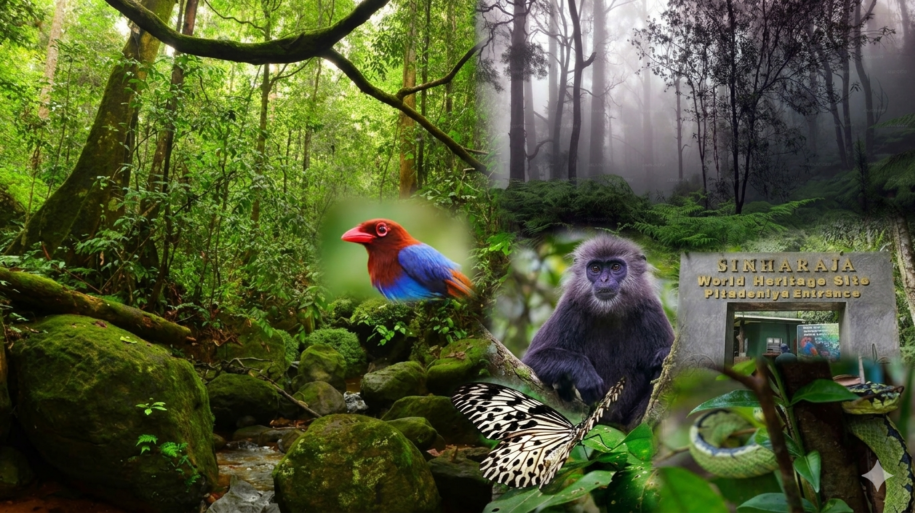
“Sinha” means lion. One of Sri Lanka’s major official languages is Sinhala, and the people who speak it are called Sinhalese. Even the popular rock fortress at the heart of Sri Lanka’s cultural triangle is called “Sinhagiri” or Sigiriya, meaning Lion Rock. In addition to this list, the last remaining extensive primary lowland rainforest in Sri Lanka is Sinharaja Forest Reserve (Lion King Forest). Each of these holds a unique long-standing bond with the beast. Yet, there are no lions in Sri Lanka.
How so? How did a being with such deep and massive cultural significance disappear from the island? How is the Sinharaja forest reserve linked to it?
What happened to the Sri Lankan Lions?
Panthera Leo Sinhaleyus is the scientific name for the subspecies of lions that once inhabited Sri Lankan lands. It is said to look physically much larger than the Indian lions of today. The palaeontologist, Paulus Deraniyagala, who named this species, derived its name from the Sinharaja rainforest of Sri Lanka, from where he got the first prehistoric fossil (a molar tooth) in 1938. This is what resulted in the discovery of Sri Lankan lions — a lost subspecies. For now, this means Sinharaja Forest Reserve is the last and only known land in Sri Lanka with scientific evidence to say majestic lions once roamed around this island.
An interesting fact about the extinction of Sri Lankan lions is that it did not happen in recent times, but in 37,000 BCE. As per recorded history, this is the period when Homo Sapiens were growing in number and symbolic behaviour such as tool-making, art, and music were born. However, one cannot easily arrive at the conclusion that humans were a reason or the sole reason for this tragedy. During this period, geographically, Sri Lanka was a very different place. It was an island of open grasslands, making it an ideal habitat for lions. This is not the case now. Rainforests such as Sinharaja eventually flourished with numerous trees due to the monsoon, which also could have restricted the living space for lions. But were lions the only affected animals?
The Big Brothers of Sinharaja Forest Reserve
Particularly in Sinharaja Forest Reserve, another majestic being was almost facing a similar tragedy, if not for Loku Aliya and Panu Kota (brothers) — the last two remaining elephants, as named by the villagers. The place used to have a larger elephant population of around 40-50 in the 1920s. But with colonial tea plantation encroachments, human-elephant conflict, and habitat loss, the number has reduced to a mere two, although found in large numbers across other parts of the island. It’s sad how human activities such as logging, poaching, and habitat fragmentation throughout history have resulted in the similar extinction of many other animal species in this region. Even agriculture, which is the basis for human settlement, has affected wildlife. For instance, as per the 1870s report, the traditional chena cultivation that involves a slash and burn method had eaten up the north and northwestern sides of the then vast forest area.
Sinharaja — Name Origin Story
Let’s trace back something. If the lions in the Sinharaja forest reserve went extinct around 37,000 BCE, and if the Sri Lankan lion’s existence was proved and named only in 1938 after discovering the fossil,
- How did the Sinharaja rainforest get its name in the first place?
- Why did the people of Sri Lanka name several important places after lions, and how did it grow into a culturally important animal?
To answer the first question, even before the excavation, the Sinharaja forest reserve was considered by Sri Lankans to be the final stronghold of the last standing lion in Sri Lanka. The factuality of this has not yet been proven. There is also a folklore about a mythical lion that lived in the forest, representing a spiritual connection between the people and the island. This also could have been the reason for the name “Lion King Forest”. In addition to these, there’s a belief that the forest was a forbidden territory of an ancient Sinhalese “Raja” (King). Nevertheless, with Sri Lanka’s recorded history missing beyond the past 2500 years, it’s hard to say the exact origin of the name. As far as we know, due to local beliefs and taboos against entering or damaging the forest, this remained a largely unexplored rainforest until the 1930s. The answer to the second question is a mystery that only the unrecorded history and maybe some archaeologists can answer.
What makes Sinharaja Forest a UNESCO World Heritage site?
Sinharaja forest reserve is a narrow belt of wet zone rainforest in the southwest of Sri Lanka. With an area of approximately 11,187 hectares, it stretches across 21 km east-to-west and 7 km north-to-south.
As per the guidelines of the World Heritage Convention, to be included in the list of 1240+ UNESCO World Heritage sites, it must meet at least one of the ten criteria that mark exceptional universal value. Sinharaja rainforest satisfies the following two criteria:
(ix) to be outstanding examples representing significant ongoing ecological and biological processes in the evolution and development of terrestrial, freshwater, coastal and marine ecosystems and communities of plants and animals;
(x) to contain the most significant natural habitats for in-situ conservation of biological diversity, including those containing threatened species of outstanding universal value from the point of view of science or conservation.
Step-by-Step Recognition
1. Forest Reserve
For a long time, the Sinharaja rainforest was just a remote jungle that remained relatively undisturbed until the 1800s due to its poor accessibility. Despite its dense, difficult terrain, there are records of occasional timber logging by the Portuguese (16th century) and British. During the 19th and mid-20th century, the Britishers went on to clear the coastal and upland areas for coffee and tea plantations while sparing the steep valleys. In order to curtail this, the area was formally reserved for protection by the government on May 3, 1875.
2. Expanded protection
From the 1960s up until 2020, there were multiple logging attempts, an organic tea plantation establishment attempt, wildlife smuggling cases, illegal hydropower issues, and roadworks-related issues. As international and local awareness grew, these moves were regularly fought against by conservationists, the government, and public activists to protect the richness of this forest. As part of this process, the forest reserve area was expanded in the 20th century.
3. Biosphere Reserve
It all began with Henry Trimen, a British Botanist who published “A handbook to the Flora of Ceylon”. Although his research did not centre on the Sinharaja rainforest alone, his study showed that many plants in Sri Lanka are endemic.
Next, when the Forest Department of Sri Lanka started mapping forests, recording tree types, and managing timber use, they noticed how Sinharaja is a dense, untouched rainforest, and how it is different from other forests regularly used for logging. It began to be recognised for its enduring original and rare nature.
Slowly, the focus shifted from trees to animals as Sri Lankan scientists studied mammals, reptiles, and fossils. Unique Sri Lankan animals were identified with early observation of how rainforests like Sinharaja hold rare species.
At one point, scientists and university research teams got into systematic field studies to set paths through the forest, count birds, frogs, and insects, collect plant samples, and compare species with other regions. Here’s what they discovered:
- Sinharaja forest is a critical, exceptional, global, and one of the richest biodiversity hotspots in the world, featuring extreme endemism. Thanks to the timely recognition and conservation, it is one of the few remaining “virgin” tropical rainforests in the world that hasn’t been subjected to large-scale commercial logging.
- With over 60% of its trees, 95% of its birds, and over 50% of its mammal, butterfly, and reptile species being endemic (not found anywhere else in the world), the reserve protects rare flora and fauna. More precisely, this reserve alone encompasses 139 of 217 Sri Lankan endemic wet‑zone tree species and 19 of the country’s 20 endemic bird species, such as the Sri Lankan Blue Magpie and Red-faced Malkoha. Besides being rare, it’s also notable for endemic animals such as the Sri Lankan leopard, Asian elephant, and purple-faced langur.
- Since the rainforest has remained largely undisturbed for a really long time, it holds scientific evidence of how Sri Lanka was once attached to the Indian subcontinent when multiple southern continents existed together as a single Gondwanaland around 200 million years ago. The fossils, living ancient plants, and endemic animals lay bare a perfect environment to study continental drift and ecological evolution. For researchers, the Sinharaja rainforest is a living museum of Gondwanan ecology.
All these reasons influenced UNESCO to declare this forest a Biosphere Reserve in 1978.
4. World Heritage Site
There were multiple factors that made UNESCO, with help from the International Union for Conservation of Nature, decide in 1988 that the whole world should come together to protect the Sinharaja forest reserve as one of the most special places on earth, as a UNESCO World Heritage Site.
- Solid scientific research highlighted the high number of endemic species that are completely unique and irreplaceable.
- Evidence showed that most of Sri Lanka’s rainforests were already gone, and Sinharaja was the only remaining untouched one.
- Mixed-species bird flocks (different birds moving together) are a rare phenomenon observed in this forest.
- It wasn’t just a few animal and plant species that continued to live as per natural evolution and hierarchy without any external disturbance. The whole tropical rainforest ecosystem is functioning naturally, depending on each other, as per nature’s will, for a really long time.
- Despite the local government’s rules, activities like logging and poaching kept happening in the area. International attention ensured more pressure to protect it.
- The Sinharaja forest reserve has an intricate network of creeks and ridges. Dense multi‑layered rainforest canopy and steep stream‑cut terrain (e.g. the Gin River gorge) provide habitat for dozens of rare species.
Conservation and Healing
As soon as UNESCO declared the Sinharaja forest reserve a World Heritage Site, the Sri Lankan law declared it a National Heritage Wilderness Area in 1988. It is the highest level of legal protection in Sri Lanka that strictly controls access and permits only those with a licensed guide. When it comes to the Forest Department, their priority is always conservation over tourism.
For decades together, in order to protect Sinharaja’s rich biodiversity, the Sri Lankan government, as well as NGOs, have constantly launched conservation initiatives such as buffer-zone programmes, NGO land purchases, and forest reserve surveys through strategic management plans, reforestation projects, and structured community programs. They aimed to redefine boundaries, protect, and do as much habit restoration as possible. Often cited as the flagship rainforest, Sinharaja forms the national identity around biodiversity.
After all these conservation efforts, recent studies show a beautiful success picture: now there is no visible difference between the primary remnant forest and the expanded secondary forest. The living rainforest has healed from its past disturbances with increased canopy height and tree density in the main areas. However, except for popular species like elephants and leopards, the regeneration of certain rare endemics is quite low. Although Sinharaja forest reserve has recovered very much, the nearby forests have always continued to face exploitation issues from external pressures, resulting in significant loss.
Local Communities and Economy
There are nearly 32 villages (around 13,000 people) in Sinharaja forest reserve’s buffer zone, such as Deniyaya and Kudawa. While just a small percentage of households rely on minor non-timber forest products (e.g. Caryota urens jaggery, Coscinium “Weeni weeni” medicine) through sustainable harvests, most local communities have historically practised shifting cultivation of tea, rubber, spices, or rice farming, besides small enterprises.
In recent decades, ecotourism has become a vital income source for the locals. Villagers serve as guides, forest monitors, home-stay operators, and craft sellers – an arrangement encouraged by the Forest Department. For example, the DFO’s Sinharaja Sumithuro (Friends of Sinharaja) programme trains locals as official guides and promotes benefit-sharing.
This entwinement of livelihoods with the forest’s well-being is credited as part of Sinharaja’s conservation success. Visitors today encounter a mosaic of primary forest, secondary regenerating patches, and interstitial farmland, experiencing both the raw forest and its cultural edge.
For the Ecotourist in You
Today, Sinharaja Forest Reserve stands as Sri Lanka’s finest eco-adventure—a place you learn to move through, slowly and quietly.
Entry is carefully controlled through a permit system, ensuring that the forest remains undisturbed. Once inside, there are no wide roads or hurried itineraries—only narrow mystical trails winding through dense green, streams crossed on rustic log bridges, and a rhythm set entirely by nature. As a result, the forest reveals itself only to those willing to pause.
The experience begins with the senses. The air is thick with humidity, carrying the scent of wet earth and moss. Sunlight slips gently through layers of towering trees, creepers, and ferns, casting shifting shades of green across the forest floor. The soundscape is alive yet subtle—the murmur of flowing water, the distant call of birds, the steady hum of insects.
Wildlife appears when you least expect it, as a flash of colour from a Sri Lankan blue magpie, a troop of toque macaques at a fruiting tree, a quiet movement of a purple-faced langur in the canopy, or a Malabar tree nymph butterfly resting almost invisibly on a leaf. With the help of experienced local guides, even the smallest details could amuse you—a camouflaged pit viper coiled along a vine, or a tiny owl blending perfectly into the bark.
What makes Sinharaja unforgettable is this sense of discovery. Nothing is staged. Every step holds the possibility of something new, something easily missed without patience. Photographers often arrive hoping to capture towering trees, only to find themselves captivated by a single orchid or a hidden frog.
What to Know Before You Go
A journey into Sinharaja Forest Reserve begins long before you step under its canopy. It is a carefully protected one, where every visit is intentional.
Entry and Permits
Sinharaja is co-managed by the Divisional Forest Officer (Deniyaya) and Ranger (Kudawa) under the Conservator of Forests. Ranger‐enforced rules forbid unauthorised entry or solo treks. Every visitor, particularly for research or special photography, must obtain a permit (preferably in advance), usually arranged through the Sri Lanka Forest Department either online or at a Divisional Forest Office (DFO). Permits are issued per person, per day, and entry without one is not allowed. As video cameras or drones may incur extra fees or bans, it’s better to check once with the authorities.
Visitor Facilities
Sinharaja forest reserve remains intentionally undeveloped. There are no visitor centres deep inside and no modern facilities beyond the entrance points. A small conservation office near Kudawa marks the edge of human infrastructure.
Restrooms or water are only available at the gate or nearby villages. Trailheads have simple shelters but no shops. In practice, day visitors carry food/water or use small local tea‑shacks in buffer villages. Camping inside the core reserve is not allowed.
Guides
You cannot explore Sinharaja alone. A licensed local guide is mandatory—not just for regulation, but because the forest itself demands it. Its trails are dense, layered, and easy to misread without someone who knows its rhythms. Local guides, often from nearby villages like Deniyaya and Kudawa, are an essential part of the journey. More than merely leading the way, they know how to find wildlife. They help spot skittish species and carry out small wildlife surveys (e.g. fruit baiting for butterflies). Many guides are found via local accommodations or tour operators.
Accommodation
There are no hotels within the reserve itself. Instead, small guesthouses, eco-lodges, and homestays in nearby villages offer simple, nature-focused stays.
Food & Supplies
Restaurants in Deniyaya or Kalawana serve local Sri Lankan and simple Western meals. In forest villages, expect only small tea shops or packed snacks. Though streams are potable, they could still have leeches and microorganisms. Rather, it’s wise to carry sufficient water (filtered or bottled), bring energy food (bars, fruit, biscuits), pre-downloaded maps, and a headlamp for rooms without power. Particularly during heavy rains, some lodges could lose electricity, and mobile signals might become unreliable.
Best Seasons
Sinharaja is a rainforest. So, unquestionably, it rains year-round, with two monsoons (SW May–July; NE Nov–Jan), sometimes without warning.
The relatively drier months—February to April and August to October—offer easier trails and better wildlife visibility. Butterflies are especially abundant in March–April and September–October, while bird breeding and fruiting trees are most active in the late dry season.
During monsoons (May–July and November–January), trails can flood, but the forest comes alive in other ways—frogs, dragonflies, and flowing streams dominate the landscape.
Daily Schedule
For wildlife photography, plan to be in the forest at dawn and dusk, with a midday break. Birds are most active in the first 2–3 hours after sunrise, and again just before sunset. For example, 5:30–9:30 AM is prime for bird flocks and canopy species. Mammals (langurs, macaques) are often seen in mid‑morning at forest edges. Insects (butterflies, beetles) are abundant from 9:00 AM–noon when the sun hits clearings. Late afternoon (4:00–6:30 PM) is good for photographing forest skinks, frogs emerging, and colourful butterflies returning to sheltered spots.
Night photography: hire your guide for a night walk (headlamp/UV). After dusk, search near streams and forest floor for owls, tree frogs, snakes and large moths. (Nocturnal tours may require special permission.)
Rules That Protect the Forest
Sinharaja forest reserve is protected for a reason: it is fragile. Visitors are expected to move carefully: stay on trails, avoid disturbing wildlife, and never feed animals, as this alters behaviour and can spread disease. Collecting plants or insects is illegal. Drones and artificial sound playback are banned. Even photography requires restraint—flash can harm sensitive species. These rules are the reason the forest still exists in its original form.
Safety in the Wild
The forest can be demanding. Trails are often wet, steep, and slippery. So, sturdy waterproof hiking boots with traction are essential. Wear long-sleeved tops and long pants to minimise scratches from sharp plants or bites from centipedes or mosquitoes. Since leeches are common, especially after rain, wearing protective socks and repellents helps. Regularly check and remove leeches with salt or alcohol (don’t use bare hands). Beware of biting midges (sandflies) near streams – repellents help, especially late afternoon. Carry enough water and a light source if you plan to stay late.
Medical facilities are located outside the forest, in the nearby Deniyaya/Kalawana, while major hospitals are in Galle/Ratnapura. Nevertheless, a basic first‑aid kit (antihistamine, bandages, antiseptic, rehydration salts) is recommended. Always listen to the guide’s warnings while trekking through Sinharaja Forest Reserve as flash flooding can occur in streams.
What Makes It Special
Wildlife in Sinharaja is rarely obvious. Many animals are shy, endemic, and adapted to remain unseen. But that is part of its charm. Every sighting feels earned—whether it is a fleeting bird call, a hidden frog, or a butterfly resting quietly in filtered light.
For photographers, researchers, and nature lovers alike, Sinharaja is less about ticking sightings off a list and more about learning how to observe.