
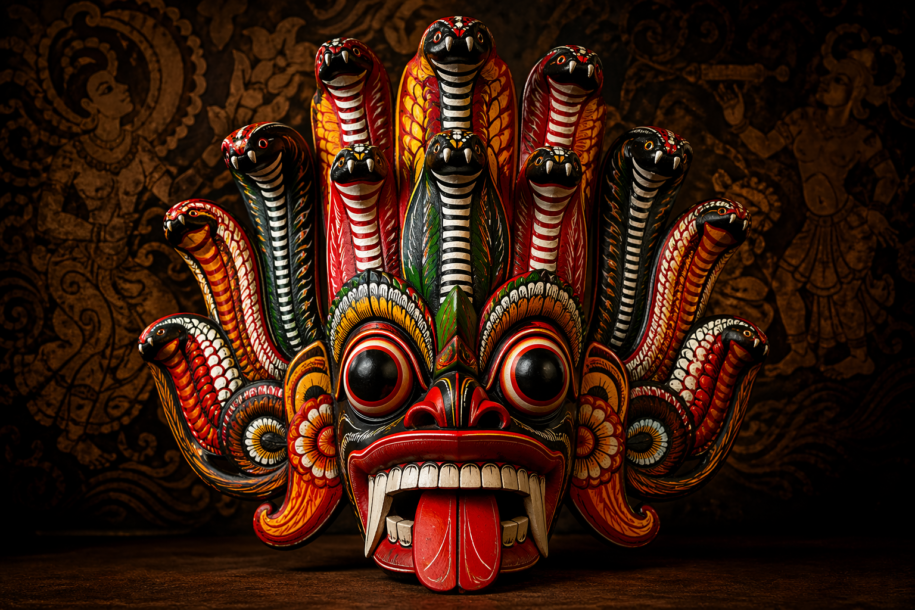
You are in the cultural capital of Sri Lanka, witnessing the Kandy dance show. A man in white and red traditional wear is playing a double-headed drum as if prepping the audience for the arrival of someone. As anticipated, a character enters the stage in a multicoloured folk-theatre attire and a mask. With no second thoughts, the entire audience’s focus moves to the elaborately painted masked head. The exaggerated movements of the head with its eyes bulged out, protruding tongue, beastly canine teeth, and multiple hooded cobras in place of hair resolutely push you into the folklore world. As the masked character moves to the rhythm of the drums, his metallic anklets vigorously tinkle in complement. Just as you start getting a vague idea of the context, another masked character with more unnatural features enters quickly, interacting with the existing character through firm movements. There’s no language involved, but now you understand an entire mythological story that is part of Sri Lankan heritage for centuries. Yet, that’s just a prelude to the world of Sri Lankan masks.
Behind the Sri Lankan masks hides an almost-buried tradition that refuses to let go of its practitioners and people. Though these cannot be found all over Sri Lanka, with the boom of the tourism industry, these have found a place for themselves on the face of Sri Lanka. Once the core of night-long healing ceremonies, extended rituals, and village theatre, now just occupy a space where the scared and the stage blur. Frozen with dramatic expressions and painted in bold pigments, these are primarily linked to Hindu and Buddhist cultural traditions — each connecting the local folk beliefs to mythological stories on morality. When studied in depth, they are a living philosophy of the world, where every emotion, illness, social status, and moral thought is given a voice, face, and a place in performance.
The Three Worlds of Sri Lankan Masks
Sri Lankan mask tradition classifies them into three broad types based on their context and purpose. However distinct they seem, on a deeper level, they are fascinatingly interwoven and layered.
- Kolam masks used in folk theatre to satirize hierarchy in rural societies
- Sanni masks used in healing ceremonies and exorcism
- Raksha masks used in religious processions to ward off evil forces
Apart from these, there is a fourth type of mask called ‘Pali or Ves masks’ as per some folk traditions, which anyhow overlap with or are derived from the three principal types.
Kolam Masks
Before the advent of cinema, throughout the world, theatre ruled the role of spreading morality and ethics through entertainment. Written records say that Kolam drama is in fact two centuries old. In Sri Lanka, tourism seems to be one of the hands holding it from disappearing into a memory. Mostly held in open-air, Kolam is a non-verbal masked dance drama that imitated official characters like kings, queens, soldiers, clowns, and village characters, enacting stories to address taboos and teach the distinction between vice and virtue. Besides satires that poke at social hierarchies and point out human folly, mythological stories like episodes from Ramayana (Hindu epic) and local folklore are also enacted with invocations, and religious rituals interwoven in the drama. Since the masks used in these are made of wood and not facepaint, characters can swiftly change roles, except sabhapati, the chief storyteller, who remains unmasked.
Historically, they were often performed by coastal fishing people during community festivals, weddings, harvest celebrations, temple offerings to Pattini (goddess of fertility) or other agrarian deities, and rituals. Though classical scripts like Shariputraya and Rupawaliya preserve these theatrical stories, there is a mythical story behind the origin of Kollam: once there was a 15th century queen who was pregnant and craved for entertainment programs. No art or artist in the kingdom was able to fulfill her wish. That’s when Indra, the Hindu God of creation, fashioned the first Kolam masks. When the artists performed a dance-drama with the masks, the queen was satisfied, and thus the art originated. Customarily, the drama could go on for more than five nights, although reduced to a mere few-hour cultural show or museum demo in the current times. Certain Kolam elements have also been fused into other dance forms in recent days.
Sanni Masks
Sri Lanka is known to have rich and widespread Ayurvedic knowledge that is still practised across the island. Nevertheless, popular beliefs that supernatural forces are causing varied illnesses have always existed amongst rural populations, particularly for unidentified illnesses. As a result, exorcisms and healing ceremonies were commonly done in hope of ailing the sick ones.
According to Thovil or Sanni Yakuma exorcisms, each mask is a sickness-demon personified. While the chosen mask for the ceremony denotes the disease the patient has, the belief is that heavy drumming, dancing, chanting, offerings and ritual combat will force that demon out of the patient, thus healing them. This Sinhala tradition lists around 18 main Sanni demons, each named after an illness. For instance, Amukku, the vomiting demon, is linked to stomach disorders; Bihiri is for deafness; Kora represents paralysis or lameness; and Pith is the demon for bilious conditions such as jaundice.
The masks representing these sickness demons are intentionally made to appear grotesque with missing eyes, protruding tongues, greenface, etc. as a way of visualising the suffering beneath. During the elaborate healing dance, the disease-related afflictions, origin, and results are acted out by the performers. For possession-related overnight ceremonies, the story of the possessed spirit will be enacted. At the end of the performance, the main exorcist finally appears as Maha Kola, the supreme and all-encompassing demon, whose mask will have miniatures of all 18 demon-spirits. The subjugation of this chief demon is believed to flush the disease out of the patient.
Raksha Masks
The word “Raksha” in Sri Lankan language has two meanings — Demon and Protector. While Sanni masks represent the evil demons of illnesses through their ghastly features, Raksha masks, despite possessing wide eyes, fangs, and tongues, serve a protective or guardian role. They generally represent powerful beings like cobra-demon (Naga), hawk-demon (Gurulu), peacock (Mayura Raksha), and death-demon (Maru Raksha – invoked to delay fate). Certain folklore bridges Rakshas (demons) with Ramayana epic that features the Sri Lankan king Ravana and his demon community, whereas few others relate the animal-like masks to the steeds of Hindu Gods. There are said to be 24 Raksha forms that once existed, of which only a few are now used. Some interesting features about these masks are the presence of multi-faces, headdresses like wigs, fires, snakes, and the comparatively large sizes. Raksha masks are typically used in religious processions (Peraheras), temple festivals, funerary rites to protect the dead from evil spirits, seasonal agricultural ceremonies, to bring good fortune or luck, for decorative purposes in recent times, and at house entrances to ward off evil and invite auspiciousness.
Mask-Making Craftsmanship
The art of mask-making is a skill passed on through generations of professional artisans as it requires well-experienced hands to get the details and proportion right. The Sanskrit manuscipts ‘Shariputraya’ and ‘Rupawaliya’ detailly instruct the standards to maintain, including the colour for each character, and the rituals to follow in the process of mask-making. In order to hand-carve these masks, while light soft woods such as timber (locally called kaduru) is traditionally used, other woods like Walkaduru, Rukattana, Erabadu and Kapupulun are also used.
The first step is to smoke-dry the logs for weeks to prevent the mask from future cracks and insects. The wood is then outlined by an expert craftsman, followed by chipping it out using hand tools like chisels, mallets, and axes. Abrasives and whetstones are then used to do fine shaping and smoothing. Enlarged features that add to the scary effect of the mask such as the projected eyes, ears, and teeth are usually carved separately and then attached.
Here’s where it shows how connected the masks still are to its roots: Except few modern workshops that use power tools and synthetic paints for the sake of efficiency, many traditional studios still insist on using paints extracted from natural sources. Reds and browns are from iron-rich stones or clay, yellows from kirigal (wood bark), whites from makulu mati (earth), and greens from various plants. There’s more. After painting, these masks are sealed with lacquer or resin to add intensity to the colours as well as protect the wood for decades. Due to these well-thought out processes, a single complex mask can take weeks to be completed.
Where to find the Sri Lankan Masks?
You may find Sri Lankan masks sold in many areas like Colombo suburbs, made and sold by urban artisans without any ritualistic methods primarily for sale. But, the authentic ones aren’t found that easily. The southwestern coast is the true mask-making hub of Sri Lanka. Particularly, Amabalangoda in Galle district is well known as the “Mask Capital”, where the families of the Karava community such as Ariyapala/Wijesooriya and Tukkawadu have been passing on this skill as an invaluable inheritance through generations. There’s also a curious habit these artisans had: they possessed personal collections of retired masks which they kept wrapped in red cloth in order not to anger the demon.
Based on the classifications established between 1930s-50s, it was the Amabalangoda artists who standardised many Kolam and Sanni masks for the 20th century. Of them, the Ariyapala family has solely carved a complete set of nearly 120 masks for the sake of cultural preservation. Now, in modern day temple processions such as the Kandy or Colombo Peraheras, these Sri Lankan masks just appear as small exhibits or as decor. The actual usage happens at the principal traditions of Ambalangoda festivals such as the Sinhale Pujapitiya and at the Buddhist temple events in the south.
The following are some of the best places to view authentic masks in person, learn about them in detail, and participate in mask-making:
- Ariyapala Traditional Masks & Museum (Ambalangoda)
- Mask Museum of Ambalangoda
- Sithuvili Arts Centre
- Some roadside stalls, temple fairs, and international fairs
Contemporary Status of Traditional Sri Lankan Masks
Now that people understand the science behind each disease, even the rural settlers prefer a quick medicine over Sanni mask ceremonies. With temple rituals, dance drama programs, and few other places as the only remaining traditional uses of Sri Lankan masks, they have become more of a cultural commodity in contemporary times. Now, the artisan families of Ambalangoda largely thrive and earn by catering to tourists in varied ways:
- Carving masks based on demand
- Selling masks in souvenir shops and craft shops
- Conducting live mask-making workshops (e.g.Sithuvili studio)
- Teaching mask-painting to travellers
Economic Impact: Handcrafted products hold a special value for a reason. Each one is artistically crafted by a skilled person by personally choosing the sources and ritualistically following the processes. This is why people who buy it for the purpose of attracting luck prefer to purchase only from authentic places. Now with the influence of tourism, although carvers are saved from losing their livelihood, they are at times pushed to simplify the designs or stylise them for sale. Considering the fading light on Sri Lankan masks, craft cooperatives and government bodies like the National Crafts Council have ensured to mark mask-making as intangible heritage. Similarly, organisations like Tourism Authority and EU’s heritage grants have taken efforts to fund mask festivals and museum projects.
Nevertheless, there is a question that lingers with respect to tradition: as these masks travel further from their original contexts, are they losing something, or simply evolving, as they always have, into whatever the present moment asks them to be?