
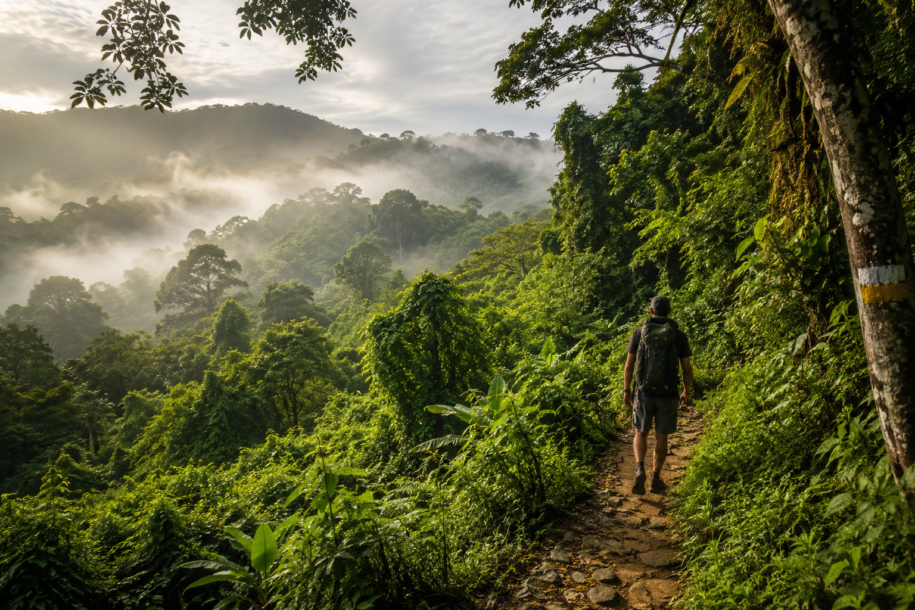
Hidden forest trails in Sri Lanka don’t show up on most itineraries. Not because they’re hard to find exactly — but because nobody tells you to look. The standard two-week Sri Lanka trip fills up fast. Sigiriya on day three, Yala on day seven, the train to Ella somewhere in between. All of it is good. None of it is quiet.
What most people miss — and what this article is really about — is the other Sri Lanka. The one that exists just off the edge of the tourist map. Forest trails where the only sound is the canopy above you doing whatever canopies do. Routes that local guides have walked a hundred times and visitors stumble onto maybe once, if they’re lucky.
If you’ve ever arrived at a famous viewpoint, looked at the fifty other people already there, and quietly wondered if there was somewhere else — there is.
Why These Trails Stay Hidden
It’s not a conspiracy. Nobody is keeping them secret. The simpler explanation is that hidden trails require effort the famous sites don’t. There’s no shuttle service, no ticketing app, no TripAdvisor listing with 4,000 reviews telling you exactly where to stand. You have to ask the right person in the right guesthouse and be willing to follow instructions that involve a tuk-tuk, a dirt road, and a guide who doesn’t speak much English but knows the forest better than anyone.
Most travellers aren’t set up for that. They’ve got a limited window, a pre-booked itinerary, and a list of things they can’t leave without seeing. That’s completely fine. It also means the trails stay quiet for the ones who do come.
The Trails Worth the Effort
Sinharaja Forest Reserve – Go Past the Main Path
Everyone who visits Sinharaja does the same thing. Kudawa entrance, standard trail, guided walk, a few good bird sightings, back to the guesthouse by lunch. It’s a decent morning. It’s also about a fifth of what Sinharaja actually is.
The forest runs to 88 square kilometres. The tourist trail covers a small corner of that. The rest of it — older, denser, louder with things you can’t immediately identify — sits largely untouched because nobody asks to go there.
A licensed guide is how you access it. Not the kind of guide who walks slightly ahead of you pointing at trees — a proper Sinharaja guide who grew up near the forest and knows it section by section. They’ll have you off the standard path within twenty minutes and into something that feels genuinely wild within thirty.
A few things worth knowing before you go: leeches after rain are not a rumour. The humidity is real. The mud on the less-travelled sections can be properly deep in wet season. None of this is a reason not to go. All of it is the experience. Dry season between January and April, or the shorter dry window in August and September, gives you better underfoot conditions — but the forest is worth visiting in almost any weather if you’re prepared for it.
Knuckles Mountain Range
The Knuckles Range is northeast of Kandy and it is, genuinely, the most underrated hiking destination on the island. Ask most tourists if they’ve heard of it and they’ll look at you blankly. Ask most serious hikers who’ve spent real time in Sri Lanka and they’ll tell you it’s the best walk they did.
It doesn’t have a famous image. No single viewpoint has been photographed enough times to make it iconic. What it has is a network of trails through terrain that changes as you climb, micro-climates that mean one section of forest feels completely different from the next, and wildlife that includes things you don’t see in the more visited parks. The Knuckles Range forms part of the UNESCO Central Highlands World Heritage Site — a designation that reflects just how ecologically significant this landscape is, even if the tourist numbers don’t yet reflect that.
Corbett’s Gap
Start here if the Knuckles is new to you. The trail from Corbett’s Gap moves through montane forest where the cloud comes and goes as it pleases — sometimes you have a view across the range that stretches for what feels like half the island, sometimes the mist is so thick you can barely see the path ahead. Both versions are good. The vegetation shifts noticeably as you gain elevation, from thick jungle lower down to something older and mossier near the top. Purple-faced langurs appear regularly. Birdwatchers tend to lose track of time here entirely.
It gets steep in sections. After rain it gets slippery fast. Worth every bit of it.
The Nitre Cave Trail
This one barely gets mentioned even in guides that cover the Knuckles fairly thoroughly. The trail winds through dense forest before arriving at a cave formation that most visitors to the range never know exists. The cave is impressive — cool air, unusual formations, the kind of place that takes you off guard. But it’s the walk in that justifies the trip. Stream crossings, sudden open viewpoints, sections of forest that feel like nobody has walked them in weeks.
Don’t attempt this without a local guide. The trail is poorly marked in places and the landscape changes faster than any map accounts for. Arrange through a guesthouse in Kandy or one of the small villages at the range’s edge — guides here are local in the most literal sense and the difference shows.
Kelani Valley Forest Reserve
This is the outlier on the list. No UNESCO designation, no established reputation, no organised tour operators pushing it in Colombo travel agencies. The Kelani Valley Forest Reserve sits in the wet zone near Kitulgala — which most people know only as the place you go white water rafting — and the forest above the river gets almost no foot traffic.
The trails cut through secondary forest that’s been slowly regenerating for years and is now thick enough to feel genuinely immersive. The birdwatching is exceptional — serious birders who stumble onto this area tend to come back. The wildlife on the forest floor is more active than in heavily visited areas, for the simple reason that it hasn’t been habituated to human presence. Things move in the undergrowth here that you’ll hear before you see, if you see them at all.
It’s not dramatic in the way that the Knuckles is dramatic or biodiverse in the way that Sinharaja is biodiverse. What it is, is uncrowded, genuinely wild, and completely honest about what it is. An easy two and a half hours from Colombo, which makes it doable as a day trip in a way that Sinharaja isn’t.
What the Trails Are Actually Like
The Conditions Are Not Managed
These are not resort walks. The ground gets muddy after rain and stays that way. Tree roots cross the path at angles that catch you when you’re not paying attention. In the wetter forest zones, leeches are a regular companion — pull your socks over your trouser legs, carry salt, and accept that it’s part of the ecosystem. Insects are everywhere at lower elevations in the warmer months.
Proper hiking boots matter. So do long trousers. A light waterproof that packs small is worth carrying even on days that look dry — forest weather is its own thing and doesn’t always align with what the sky looked like at breakfast.
Wildlife Shows Up When It Feels Like It
Sri Lanka’s forests are genuinely wild in a way that takes some adjusting to if you’ve mostly experienced wildlife in more structured settings. In the Knuckles, you might come around a bend and find yourself unexpectedly close to elephants. In Sinharaja, the endemic birds — the ones you came for — show up on their own schedule, not yours. In Kelani Valley you’ll hear things moving that you never identify.
That unpredictability is the actual appeal. A hidden forest trail is not a safari with trees. Nobody is managing what you see or when you see it. What happens, happens. That’s what makes it stick in the memory in a way that a planned wildlife encounter rarely does.
The Guide Question
Every trail on this list is better with a local guide. Some of them are only really possible with one. This isn’t the usual cautious advice — it’s practical. These trails are not well signposted. The terrain changes, the paths branch, and in heavy mist or after rain the forest looks different enough from section to section that navigation becomes genuinely uncertain.
A good local guide doesn’t just stop you from getting lost. They know where the Sri Lanka blue magpie was feeding yesterday morning. They know which stream crossing to avoid after two days of rain. They know when to stop walking and be completely still and why. The knowledge is specific, accumulated over years, and completely unavailable on any app. For a list of licensed guides and registered operators, the Sri Lanka Tourism Development Authority maintains an updated directory worth checking before you book anyone.
When to Go
Sinharaja and Kelani Valley sit in the southwest wet zone. January to April is the drier window. August and September offer another reliable stretch. Outside those periods the trails are walkable but significantly wetter — which some people find adds to the atmosphere and others find adds to the misery, depending on their tolerance for mud.
The Knuckles Range runs on its own weather pattern and is broadly accessible year-round, with February to April generally offering the clearest mornings. The range generates its own mist regardless of season so some cloud cover is almost always part of the experience — plan for it rather than against it.
For all three, early morning is not a suggestion. The first two hours after sunrise is when the forest is most active, the light is most interesting, and the heat is still manageable. Arriving at 9am and wondering why the birds have gone quiet is a mistake that’s easy to avoid.
Getting There
Sinharaja: Base yourself in Ratnapura or Deniyaya. Private transport is the realistic option. Most guesthouses in both towns have established contacts with licensed forest guides and can arrange early morning departures without much notice.
Knuckles Range: Kandy is the most convenient base, or the small settlement of Riverston if you want to be closer to the trails. Tuk-tuks reach the lower trailheads. Some of the more remote starting points need a jeep.
Kelani Valley: Kitulgala is where you stay. Two and a half hours from Colombo on a good day. Guesthouses here sit right on the river and can connect you with forest guides through local networks — ask specifically for forest rather than rafting guides, they’re different people.
Wherever you go: carry more water than you think you need, pack snacks for a longer outing than planned, and leave early enough that the morning is still cool when you start walking.
Quick Answers
Are these trails safe? Yes, with a guide and sensible preparation. The risks are mostly navigational and weather-related, both of which a good guide handles.
Do I need permits? Sinharaja has a forest entrance fee and requires a licensed guide. The Knuckles falls under UNESCO World Heritage protections with its own entry requirements. For the most current permit and entry information, check directly with the Sri Lanka Tourism Development Authority before you travel — details change periodically and the official source is always the most reliable.
Can beginners do these walks? Kelani Valley, yes easily. Sinharaja’s standard extended routes, yes with reasonable fitness. The harder Knuckles trails ask more of you — steep sections, longer distances, more uncertain terrain. For a broader overview of trail difficulty and what to expect across Sri Lanka’s nature destinations, Lonely Planet’s Sri Lanka guide is a useful starting reference.
What wildlife is realistic? Purple-faced langurs, sambar deer, giant squirrels, a range of endemic birds, and in the Knuckles, a genuine possibility of elephant encounters. Leopards exist in some areas and are almost never seen.